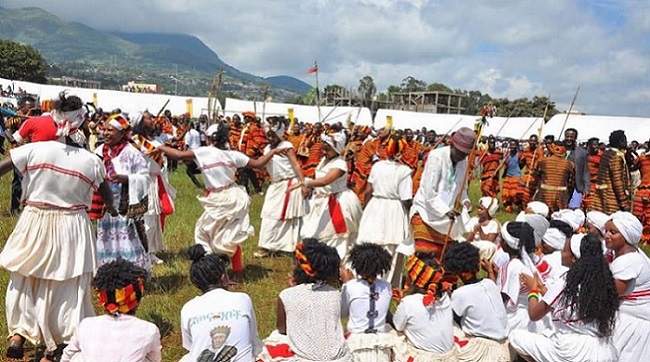
Wolaita’s New Year Festival Joins World’s Intangible Cultural Heritage
Gifaataa, the New Year festival of the Wolaita people in Southern Ethiopia, has been recognized by UNESCO as part of the world’s intangible cultural heritage, authorities announced on Wednesday.
According to the UN agency, the Wolaita community celebrates Gifaataa between mid-September and early October. Before the festival starts, people clean their surroundings and return home to be with their families. Disputes are resolved peacefully in preparation for the new year.
On the main day of the festival, families come together to share raw meat and local beer and to receive blessings from elders. In the evenings, the community gathers around a bonfire for rituals, singing and dancing. The festival lasts ten days and ends with a large community celebration known as ‘goolo-igetta’, which includes horse riding, music and final blessings from elders.
The inscription of Gifaataa on the Representative List of the Intangible Cultural Heritage of Humanity was announced during the 20th Session of its Intergovernmental Committee, currently taking place in New Delhi, India.
according to UNESCO, the new World’s Intangible Cultural Heritage list incorporates many more intangible cultures from Africa, including:
The rites of the New Year in Togo
The rites of the New Year are a series of around twenty rituals practised annually by the Guin People of southern Togo, over the course of seven months, to honour deities and ancestors. These rituals follow a lunar calendar and take place at the same times each year. The new year is marked by the most important rite, ‘Ekpéssosso’, which involves taking a sacred stone. Other key rituals include ‘Yêkê-Yêkê’, a communal meal, and ‘Kpanchonchon’, a lively parade where people paint their faces and bodies and perform expressive songs and speeches.
Mwazindika: Spiritual dance of Kenya’s Daida community
The Mwazindika spiritual dance is a traditional practice used to promote individual and communal well-being amongst the Daida community. It combines dance, music, ritual and storytelling, and is performed during important events such as rites of passage, harvests, coronations and times of crisis like droughts or floods. Its purpose is to bring healing, protection and spiritual balance. The practice begins with a preliminary ritual called ‘Kahua’, where twelve elders and youth climb a sacred hill to inform their ancestors of an upcoming Mwazindika event. Drums are made from a sacred tree, and herbs for cleansing are prepared. A traditional beverage made of honey and sugarcane is offered as libation to the ancestors.
Al-Jertiq: Ritual for protection, fertility and abundance
Among the Nubian populations residing in northern Sudan, along the Nile, up to the Egyptian border, Al-Jertiq is a ritual for protection, fertility and abundance that is held during significant life events such as marriage, childbirth and circumcision, or to mourn the death of a young, unmarried man. Although the ritual has adapted over time to different environments and social changes, its core meanings and functions have remained intact. Al-Jertiq involves a variety of ornate tools that hold symbolic meaning and are tailored to specific occasions. Each tool has a distinct purpose, such as protecting practitioners from the evil eye, bringing good fortune or promoting fertility.
Moroccan Caftan: art, traditions and skills
The caftan is a long tunic worn by people of all genders and ages for special occasions and celebrations in Morocco. It comes in different styles and fabrics and can be worn with or without a decorative belt. Emanating from diverse cultural backgrounds, the traditional garment is known for its central opening, buttons and rich, hand-made decorations, often including embroidery, beads and sequins. The caftan is worn during important social and religious events such as weddings, baptisms, coming-of-age rituals and festivals.
Tsapiky: fast-paced musical genre of Madagascar
Tsapiky is a fast-paced musical genre that combines modern and traditional sounds and is deeply rooted in the social life of the inhabitants of southwestern Madagascar. It features electric guitars, drums, accordions and local instruments such as the ‘kabosy’ (a small guitar) and the ‘marovany’ (a string instrument). Although initially instrumental, over time it has evolved to include lyrics touching on daily life, love and social issues, as well as traditional dances. Tsapiky plays a central role in community life, as it is performed at nearly every social and ritual event, including weddings, funerals, festivals and ceremonies.
Ghana’s Highlife music and dance
Highlife music and dance is a popular form of musical expression and storytelling known for its lively rhythms, lyrics and strong connection to everyday life. It features a mix of instruments, including guitars, horns, drums, xylophones and percussion. The music is often built around call-and-response singing, with the lead singer echoed by a chorus of backup singers, and is performed in many local languages, as well as in English and Pidgin. It is performed during weddings, funerals, festivals and naming ceremonies, often with lyrics that reflect current social issues such as health, education, relationships and social norms and challenges.
Mvet Oyeng: Musical art, practices and skills
Mvet Oyeng is a cultural tradition that is practiced by the Ekang community in Gabon, Cameroon and Congo. It entails the singing of a series of epic stories, accompanied by dancing and the playing of a traditional stringed instrument. The audience actively participates in the performance by playing drumsticks or clapping, singing and engaging with the storyteller. The term ‘Mvet Oyeng’ refers to the stories, the storyteller, the instrument, and the musician. There are two forms of Mvet Oyeng: sacred and popular. The sacred form is used during important events and follows a strict initiation process for transmission, whereas the popular form is more flexible and is performed during public celebrations and modern shows.
Koshary: Egypt’s daily life dish
Practices associated with Koshary revolve around a popular dish made from simple, affordable ingredients such as rice, pasta, black lentils and fried onions, with condiments such as vinegar, garlic and hot sauce added according to preference. Koshary is a filling, budget-friendly meal prepared at home and served in restaurants and street carts, especially near schools and busy areas. Although the basic recipe remains consistent, regional variations exist. Koshary is enjoyed by people of all ages, genders and backgrounds across rural, urban and coastal communities.
Guruna: cultural retreat that acts as a school of life
Guruna is a cultural retreat that acts as a school of life for members of the Massa community, located on both sides of the Logone River in Chad and Cameroon. The term refers to both the participants and the retreat itself, which takes place once a year. During this time, young boys and men move with their cattle to a camp located some distance from their homes. While girls do not stay overnight, they participate by helping with food and preparing decorations. During the retreat, young people are taught wrestling, music, dance, handicrafts and community history and values.
The Zaffa traditional wedding
The zaffa is a traditional bridal procession that marks a couple’s transition from single to married life. It involves rituals, music, dance and a festive gathering. The zaffa begins with careful preparations. The bride undergoes cleansing rituals and applies henna, while special clothes, jewellery and other adornments are prepared for both the bride and groom. During the ceremony, symbolic acts are performed to protect the couple and bless their union. These vary according to practising communities and may include drinking milk, cracking an egg or wearing a relative’s cape.
Tchiloli: living theatre of Sao Tome and Principe
Tchiloli is a traditional form of open-air theatre involving actors, musicians and an engaged audience. It is performed in an open space during festivals or public events, typically starting with a ritual led by women. Inspired by a traditional play, the story centres around a murder trial and involves about thirty actors. These actors represent different roles in the justice system: the family of the victim, the emperor and his court, and various legal and public figures. The main scene is a public trial where the emperor’s son is accused of the crime. Despite his royal status, he is judged and convicted, illustrating the value of equality before the law.