Ethiopia, Dangote Group Sign Deal to Develop $2.5bln Fertilizer Plant
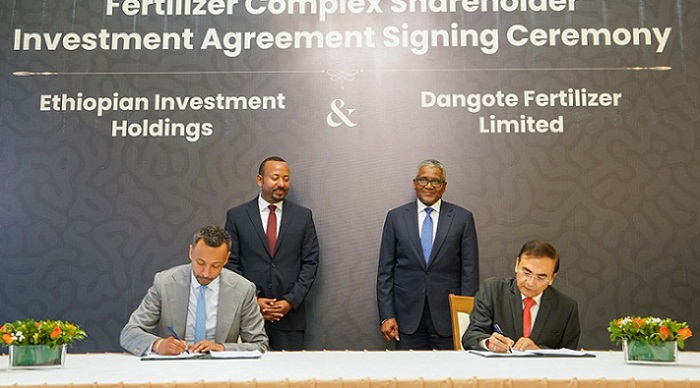
Ethiopian Investment Holdings (EIH), the strategic investment arm of the Government of Ethiopia, has entered into an agreement with Dangote Group to develop a $2.5 billion US dollar fertilizer plant in Gode, Somali Regional State.
The signing of the landmark shareholders’ Agreement today was announced by Prime Minister Abiy Ahmed on X, stating:
“Congratulations to all Ethiopians on another milestone in our journey toward food security and agricultural transformation.”
The mega project aims to produce up to 3 million metric tons of fertilizer annually, placing Ethiopia among the largest producers globally.
“This project will create jobs locally, ensure a reliable fertilizer supply for our farmers who have long faced challenges, and mark a decisive step in our path to food sovereignty,” the PM said.
“It strengthens Ethiopia’s competitiveness across the continent and reflects our commitment to executing strategic investments that serve our people and our future.”
Eye one of the world’s largest single-site fertilizer plants
EIH will hold a 40% equity stake while Dangote Group will maintain 60% ownership of the project that represents one of the largest industrial investments in Ethiopian history.
The ambitious project will establish “one of the world’s largest single-site urea fertilizer production complexes”, with production facilities boasting a combined capacity of up to three million metric tons per annum.
This capacity will position the Gode facility among the top five largest urea production complexes globally, the two entities say.
Under the agreement, the two entities will jointly finance, own, construct, and operate the state-of-the-art urea fertilizer plants and associated infrastructure.
The comprehensive development also includes a pipeline to transport natural gas from a gas processing facility in Calub and Hilala gas fields.
The agreement also outlines potential expansions, upgrades, and new initiatives in the production of ammonia-based fertilizers, including ammonium nitrate, ammonium sulfate, and calcium ammonium nitrate, further strengthening Ethiopia’s position as a regional hub for fertilizer production.
Investment and Timeline
The Project Development Costs are estimated not to exceed $2.5 billion USD, with completion targeted within 40 months from commencement.
The two sides say this substantial investment underscores their commitment to transforming Ethiopia’s agricultural sector and enhancing food security across the region.
“This partnership with Ethiopian Investment Holdings represents a pivotal moment in our shared vision to industrialize Africa and achieve food security across the continent,” said Africa’s richest man Dangote.
“We are committed to bringing our decades of experience in large-scale industrial projects to ensure this venture becomes a cornerstone of Ethiopia’s industrial transformation and a catalyst for agricultural productivity throughout the region,” he added.
Will Reduce import dependence
Authorities also expect the investment to significantly reduce Ethiopia’s dependence on fertilizer imports while creating thousands of direct and indirect employment opportunities in the Somali Regional State and beyond.
“This project aligns perfectly with our national development priorities and will substantially enhance our agricultural productivity while positioning Ethiopia as a regional hub for fertilizer production,” EIH CEO Brook Taye said.
“We are confident that this partnership will deliver tremendous value to Ethiopian farmers, contribute to food security, and generate substantial economic benefits for our nation.”
The development of the fertilizer complex is expected to play a crucial role in supporting the agricultural sector, which employs over 70% of the Ethiopian population.
It also seeks to support the broader regional integration objectives “by creating a reliable supply of fertilizers for neighboring countries, potentially reducing import costs and improving agricultural productivity across East Africa and beyond,” per EIH.