Ethiopia’s Annual Inflation Rate Slows to 13.6% in March
Ethiopia’s annual inflation rate has slowed down to 13.6% in March from 15% in the preceding month as food price pressure eases slightly, according to the country’s statistics office.
The Ethiopian Statistical Service (ECC) issued its monthly Consumer Price Index (CPI) report, which gauges the costs of commodities and services across the economy, on Friday.
The report says the magnitude of the general inflation rate steadily declined over the past twelve-months, falling 12.6 percentage points from the one observed in March 2024.
The month-on-month inflation which better captures the most recent changes of consumer prices – stood at 2.7%. It was 4.0% in March of last year.
Food Inflation Eases
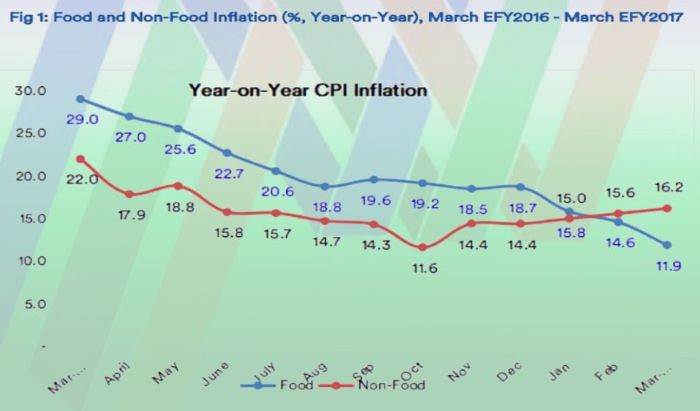
The general food inflation slowed for six subsequent months and ran at an 11.9% annual rate in March, down from last year’s 29%.
The inflation also gained 2.5% on a month to month basis due to the rise in the average prices in some of the major food and non-alcoholic components of CPI.
The prices of oils and fats saw the highest increase in March, climbing by 7.5%, and were 36.3% up on a 12-month basis.
It was followed by non-alcoholic beverages and coffee whose costs rose 6.4% on a month to month basis while the average cost of milk, cheese and eggs spiked by 5.7%. The prices of Meat (1.4%); fish and seafood (0.9%); and Food products n.e.c (3.0%) also increased during the same period.4
Non-food inflation on the rise
The annual non-food inflation rate also saw a significant drop from the levels twelve months ago, slowing to 16.2% in March 2025 from 22% a year ago.
It, however, increased by 3.2% compared to what was observed in February as the rate of inflation continued its upward trajectory over the previous few months which, according to the central bank, was caused partly due to “exchange rate pass-through effects”.
The main contributing factors were the increase in average price of commodities and services.
The CPI report says the increase in month-to-month comparison observed in health (rose by 6.4%); Hotel and Restaurants (4.7%); household equipment and routine maintenance of the house (4.1%); Recreation and culture (3.1%).
Communication (2.9%), Clothing and footwear (2.8%); furniture, electricity, gas and other fuels (2.5%); alcoholic beverages and tobacco (2.4%); Transport (1.3%); and Miscellaneous Goods and Services (3.6%) have contributed to the rise in the inflation in March, 2025.