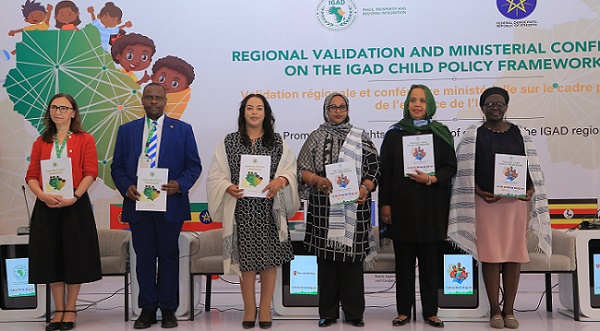
East African Ministers Endorse IGAD Policy on Rights of Children
Ministers responsible for children’s affairs from member countries of the Intergovernmental Authority on Development (IGAD) endorsed a Policy Framework on protection of children’s rights in the east region.
The policy framework was adopted on Friday during a ministerial meeting held in Addis Ababa in the presence of children’s representatives, experts, and development partners.
Ethiopia’s Minister of Women and Social Affairs Ergogie Tesfaye said the adoption of the comprehensive regional child policy framework marked a “a crucial milestone” in advancing children’s rights in the region.
“Today, we convey with a unified understanding that children are the architects of our future. Their wellbeing is not merely a moral obligation, but a fundamental pillar for sustainable development, peace and prosperity,” Ergogie said, as she underscored the gravity of this initiative to uphold the dignity and well-being of children.
The declaration, signed by ministers from IGAD member states, is said to signify a collective determination to the effective implementation of the policy, ultimately ensuring that children’s rights are respected and promoted throughout East Africa.
Mouna Osman Aden, Djibouti’s Minister of Women and Family, emphasized that the policy framework will enhance existing national child protection efforts.
Harmonizing regional policies will facilitate a more comprehensive approach to safeguarding children’s rights, and to ensure that they are effectively protected and supported, she added.
Children in the region often face a range of challenges including conflict, poverty, emergencies, climate change, violence, exploitation, inequality, discrimination, irregular migration, and displacement.
In a joint communique released at the end of the meeting, the ministers highlighted the urgent need to address the myriad of vulnerabilities faced by children
With children comprising over 47 percent of the region’s population, the ministers underscored the importance of the newly adopted policy in fulfilling international and regional commitments, while also enabling countries to implement child-sensitive initiatives that can profoundly impact the lives of children across East Africa.
Fathia Alwan, Director of Health and Social Development at IGAD, emphasized that a regional child policy framework is essential for enhancing cooperation and integration among member states.
“We recognize that achieving these goals requires sustained investment in our children and youth—the foundation of our region’s future,” Alwan said.
She also added that the adoption of the policy “underscores our collective commitment to prioritizing the rights of children in our region.”
The sentiment was echoed by Uganda’s Minister of State for Youth and Children Affairs Balaam Ateenyi.
The minister stressed the importance of regional collaboration in addressing the pressing issues impacting children, such as access to education, healthcare, and protection against exploitation.
The decision by the high-level meeting is expected to open a new avenue to foster regional collaboration to uphold children’s rights and realize their aspirations.
South Sudan’s Minister of Gender, Child and Social Welfare, Aya Benjamin Libo, said the new policy framework provides strategic regional guidance that will elevate the child rights agenda across the region.
The ministers agreed on the need to establish a rights-based and inclusive approach to national child protection systems, particularly for those affected by inequality and marginalization.
Prior to the ministerial gathering, a group of technical experts, officials, and child representatives from IGAD member countries collaborated to validate the policy framework, ensuring it meets the diverse needs of the region’s children.
With the endorsement of the policy, the ministers have tasked the IGAD Secretariat with developing a regional implementation plan that aligns with national frameworks and coordinates with member states and children. They also called for the establishment of child participation platforms to ensure young voices are heard in policy and decision-making processes.