Ethiopians Head to Polls in 7th General Election
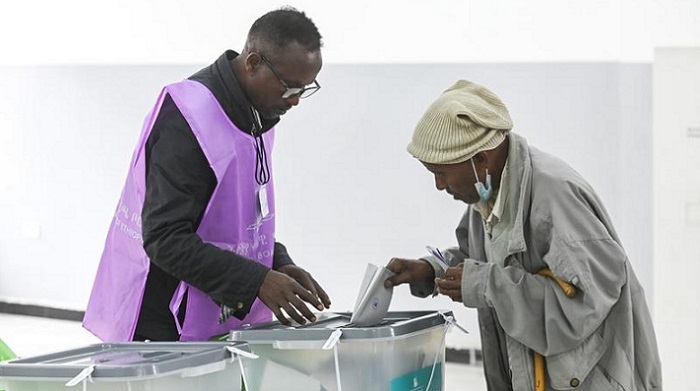
ADDIS ABABA – Ethiopians are casting their ballots in the seventh general election as election board extends voting hours beyond the scheduled closing to allow those who are already in line at polling stations to vote.
Per the National Election Board of Ethiopia (NEBE), more than 54 million people registered to vote in the country of an estimated 130 million.
HIGH TURNOUT PROMPTS VOTING HOUER EXTENTION
After about 52,000 polling stations opened nationwide on Monday at 6:00 a.m. local time, voters lined up in long queues from early morning in the country’s capital of Addis Ababa.
In line with the country’s constitution, voters will primarily elect their representatives for the House of Peoples’ Representatives (HoPR), the lower chamber of the Ethiopian parliament, as well as members of various regional state councils.
At a polling station in the Alem Bank neighborhood in the outskirts of Addis Ababa, a 23-year-old voter Khalid Bahru was waiting for his turn among a large crowd, marking his first-time participation in an election.
“I came here very motivated, as this is my first experience of voting,” Bahru told Xinhua. “Even though I arrived here before 7:00 a.m., there were already countless voters awaiting their turns.”
Election board later decided to extend the voting hours until midnight at polling stations where the voting process had not yet been completed by the scheduled closing time.
At polling stations where all registered voters have already cast their ballots, election officials are instructed to proceed with the vote-counting process.
The voting process will last for one day, as all workplaces across the country, except essential service providers, are closed on the Election Day to facilitate smooth voting.
In a message posted on X this evening, Prime Minister Abiy Ahmed commended citizens who overcame numerous challenges to cast their vote.
“The perseverance you demonstrated amid many challenges and hardships, against all odds, was a contribution made for democracy and for the very survival of the nation. For this, you deserve heartfelt gratitude.”
“It is a privilege to serve such a people. Therefore, may those who have been elected honor the trust placed in them and serve this people, with integrity and sincerity!.”
42 PARTIES IN RACE
Data from the NEBE showed that a total of 42 political parties are contesting in the general election, fielding more than 10,000 candidates under their banners, while 80 independent contestants are also running to secure seats in the HoPR and regional legislatures.
In Ethiopia, the political party or coalition that secures the majority of seats in the HoPR forms a government and selects the prime minister, who holds the highest executive power in the country.
The ruling Prosperity Party (PP) is widely expected to secure the majority of seats at the HoPR, which will enable it to form a government. The PP won 410 seats out of 484 contested in the HoPR during the 2021 election.
According to local media, out of the total 547 seats in the HoPR, 501 seats are up for grabs during the current general election. Meanwhile, in some constituencies, the election is not carried out due to security reasons.
With some experts highlighting the fragmented nature of oppositions, parties such as the Ethiopian Citizens for Social Justice and the Ethiopian People’s Revolutionary Party have also caught the attention of many voters during the campaigning period.
INT’L OBSERVERS DEPLOYED
International observers, mainly from the African Union (AU) and the Intergovernmental Authority on Development (IGAD), have been deployed across different parts of the country to monitor the electoral process.
Led by former Kenyan President Uhuru Kenyatta, the 73-member AU Election Observation Mission to Ethiopia is drawn from 37 African countries, including African envoys accredited to the AU, officials of election management bodies, and members of civil society organizations according to the AU.
The East African bloc, IGAD, has also deployed a 26-member observer mission, led by Uganda’s former Vice President Speciosa Wandira-Kazibwe.
In Addis Ababa, both missions were seen actively observing election-day procedures, including the opening of polls and voting. They are also expected to inspect the closing, counting and tabulation at polling stations.
Observers are expected to release their respective preliminary statements on their findings and assessment of the conduct of the election a few days after the general election.
– Xinhua, and other News agencies