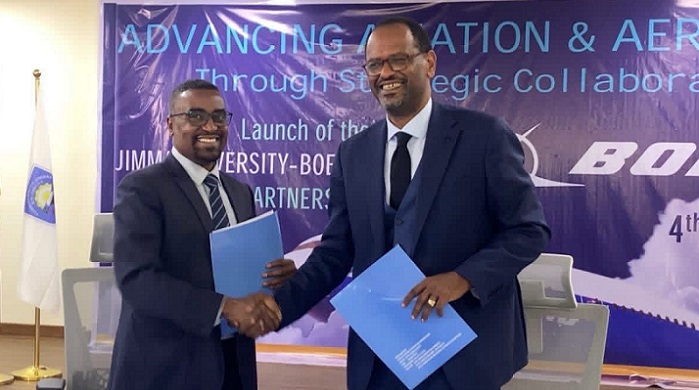
Jimma University Partners with Boeing to Advance Aerospace Education
Jimma University and Boeing have launched a long‑term partnership to enhance aviation sciences and aerospace engineering education and prepare the next generation of skilled professionals for the growing aviation sector in Ethiopia and throughout Africa.
The collaboration will support Jimma University’s recently established Aviation Sciences and Aerospace Engineering Academy with infrastructure upgrades, curriculum enrichment and community engagement programs, forming the foundation for the future Aerospace Center of Excellence.
In 2026, Jimma University and Boeing will focus on classroom modernization, faculty training, workshops and student initiatives such as the Aerospace Innovation Challenge.
The duo will also support hands-on student prototyping through the provision of technical tools and materials.
After signing the partnership agreement on Wednesday, Boeing managing director for Africa Henok Teferra Shawl said: “Ethiopia’s aviation story is one of ambition and long‑term vision, with the country advancing major airport infrastructure projects.
Henok also added, “As Ethiopian Airlines celebrates its 80th anniversary and expands its fleet, network and cargo capacity under its Vision 2035, the aviation industry is poised for substantial growth.”
“Our partnership with Jimma University will ensure talent keeps pace with that growth, and we are proud to shape the future of next generation of aviation professionals together,” the Boeing managing director for Africa said.
Aligning academic programs with industry demands, the JU-Boeing collaboration is designed as a scalable model to strengthen aviation and engineering education in Africa.
“This partnership marks a decisive step toward positioning Jimma as a center of excellence in aviation sciences and aerospace engineering, where African talent meets global expertise to shape the future of the aviation industry” said Dr. Jemal Abafita, president of Jimma University.
According to Boeing, African carriers will require 1,205 new airplanes and 74,000 additional aviation personnel over the next two decades to meet growing demand for air travel and trade.