March-May Season: Below-normal Rain Forecasted for Much of Greater Horn of Africa
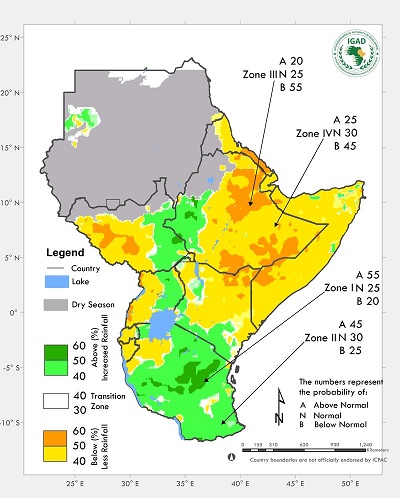
Below-normal rainfall is expected over most parts of the Greater Horn of Africa in the 2025 March to May (MAM) Season, a new ICPAC Climate forecast says.
The season is critical for the equatorial part of the region, contributing up to 60% of the annual rainfall in many parts.
The IGAD Climate Prediction and Applications Centre (ICPAC) on Wednesday released the MAM 2025 seasonal climate forecast, indicating “a higher likelihood of below normal rainfall conditions over the eastern and western parts” of the region.
The onset is expected to be early to normal in most parts of the region, except for localized areas in central Kenya, southern Ethiopia, and central Somalia, where a delayed start is likely.
Rainfall forecasts
However, ICPAC says much of Somalia, eastern and northern Kenya, southern and north-eastern Ethiopia, Djibouti, coastal Eritrea, western South Sudan, southern and western Uganda, Rwanda, Burundi, and north-western Tanzania will receive below-average rainfall.
There is also “an enhanced likelihood of below normal conditions” for the cross-border areas of Ethiopia-Kenya-Somalia, southern Eritrea, and parts of southwestern South Sudan, the center says.
Meanwhile, there will be wetter-than-normal conditions over most parts of Tanzania, eastern Uganda, eastern South Sudan, and western Ethiopia.
Temperature forecasts
The temperature forecast indicates a higher likelihood of warmer-than-normal conditions in most parts of the region.
“The highest probabilities or more than 75%” are expected over Sudan, Ethiopia, Eritrea, Djibouti, northern Somalia, and northern Kenya, according to ICPAC.
The overall projected climatic conditions are likely to have significant socio-economic impacts particularly on vulnerable populations such as women, children, older persons, and persons with disabilities.
All stakeholders have to take proactive steps to reduce these impacts on the most vulnerable populations, the Igad climate prediction center urges.